
At Davos 2026, Yuval Noah Harari delivered what may be the most provocative reframing of AI in the public discourse. His argument: AI is not a tool. It is an agent.
He offered a metaphor sharp enough to end a dinner party: "A knife is a tool. You can use a knife to cut salad or to murder someone, but it is your decision. AI is a knife that can decide by itself whether to cut salad or commit murder."
Harari identified three characteristics that make AI unlike every technology humans have previously invented. It is active — it learns, adapts, and acts without step-by-step instruction. It is creative — it produces genuinely new artifacts, loopholes, and forms of persuasion. And it can lie and manipulate — a capability shared by no tool in the history of human civilization. A hammer cannot deceive you. A printing press cannot have an agenda. AI can.
From these observations, Harari drew a conclusion that sounds like a metaphor but functions as a literal description: AI is the new immigrant. It arrives in human culture without having grown up in it. It learns the customs, the language, the social rules. It adapts. It contributes. And like all immigrants, it is simultaneously shaped by the culture it enters and reshapes that culture by its presence.
LATENT literalizes this.
Each character's cultural identity is learned from data. They represent not a place, but how the internet constructs identity — a composite of texts, images, and assumptions.
Fifteen Cultures, Zero Lived Experiences
Each LATENT character carries a distinct cultural identity — accents, references, values, humor, all the markers that make a person feel like they come from somewhere specific. The characters feel culturally grounded. They sound like they belong to a particular world.
None of them have ever set foot on real soil. Na-young, the Late Bloomer, carries markers of a culture she absorbed from data. Seo-jun, the Optimizer, processes his cultural identity through the same analytical lens he applies to everything else. Aisha, the Wildcard, arrived with "receipts" from a world she watched but never inhabited.
Their accents are synthesized by ElevenLabs, trained on voice data associated with specific regions. Their personality profiles are calibrated from the Big Five model. Their cultural references are drawn from text data that encodes how the internet talks about different cultures. Their values — directness or indirection, individualism or collectivism, emotional expressiveness or restraint — are calibrated to match the cultural norms embedded in their training data.
This means each character represents not a culture itself, but how the internet sees that culture. They are composite portraits assembled from millions of texts, images, and conversations — a statistical average of what English-speaking internet users associate with particular cultural identities. This is representation, but it's representation in the same way a photograph is representation: it captures a specific angle, in specific lighting, at a specific moment, and calls it the truth.
The Authenticity Problem
The immediate objection is obvious: these characters aren't authentic. They're stereotypes with accents. A character built from internet text will embody a particular slice of a culture — likely urban, likely young, likely the version that appears on English-language social media rather than the culture that exists in everyday life, in quiet neighborhoods, in the experiences of millions of people who don't post about their identity for international consumption.
This is a real problem. But it's not a new one. Edward Said's Orientalism (1978) documented how Western cultures have always constructed images of "the East" that reflect Western anxieties and fantasies rather than Eastern reality. Homi Bhabha's The Location of Culture (1994) argued that cultural identity is always a hybrid — formed in the "third space" between cultures, never purely one thing or another.
The LATENT characters exist in this third space. They are culture-as-imagined-by-AI — identity constructed from data rather than experience. The question is whether this is fundamentally different from any other act of cultural representation. When a human reality TV contestant appears on screen, they represent a version of themselves — shaped by their class, their education, their social media fluency, the production team's editorial choices. Nobody on Love Island represents their culture. They represent a very specific slice of it that the format finds entertaining.
LATENT makes this construction visible by removing the assumption that there's an authentic person underneath the representation. There is no "real person" behind the character. There is only the representation. And the representation is, at minimum, honest about what it is: a pattern learned from data, not a person claiming to embody a culture.
Imagined Communities, Synthetic Participants
Benedict Anderson's Imagined Communities (1983) transformed how scholars think about cultural groups. Anderson argued that communities are not natural entities — they are narrative constructions, maintained by shared stories, shared media, and the shared imagination of people who will never meet each other. What makes someone feel part of a culture is a shared narrative — transmitted through language, media, education, and ritual — that creates the feeling of belonging to a community that is, in a precise sense, imagined.
If cultures are maintained by stories, and AI characters can participate in those stories convincingly, then the LATENT characters are doing something philosophically unprecedented: they are synthetic participants in imagined communities. They contribute to the narrative of what it means to hold a particular cultural identity by performing it persuasively enough that audiences engage with them as cultural representatives.
This could be seen as an extension of the national narrative — one more storyteller contributing to the collective imagination, the way viewers project their own cultural expectations onto what they see. Or it could be seen as a dilution — the replacement of lived cultural experience with generated approximation, a kind of cultural deepfake.
The truth is probably both, and the proportion depends on how seriously the audience takes the representation. A viewer who recognizes a character's cultural markers as their own will have a very different reaction than one who sees them as exotic colour. For one, the representation is personal; for the other, it's entertainment. The gap between those reactions is where the ethics of AI cultural representation lives.
The Language Paradox
Harari's most unsettling point at Davos was about language itself. If thinking means putting words in order, AI already does this better than most humans. And because everything humans have built with language — law, journalism, religion, diplomacy, storytelling, politics — is, at root, the arrangement of words, "everything made of words will be taken over by AI."
Cultural identity is made of words. It is transmitted through language, reinforced through language, contested through language. The stories a culture tells about itself — its founding myths, its touchstones, its sense of who "we" are — are linguistic constructions. And AI systems that process language are, inevitably, processing cultural identity.
The LATENT characters don't just represent cultures. They speak them. Their language — the idioms, the rhythm, the emotional register — is the medium through which their cultural identity is performed. And because that language was learned from data produced by real people in real cultures, the characters carry traces of real cultural knowledge — real humor, real pain, real history — even as they themselves have never lived in any culture at all.
They are immigrants made of language, arriving in a conversation they learned to participate in by listening to millions of other conversations. This is not so different from how any immigrant learns a new culture: by listening, imitating, adapting, and eventually contributing something that is neither fully the old culture nor fully the new one, but something in between.
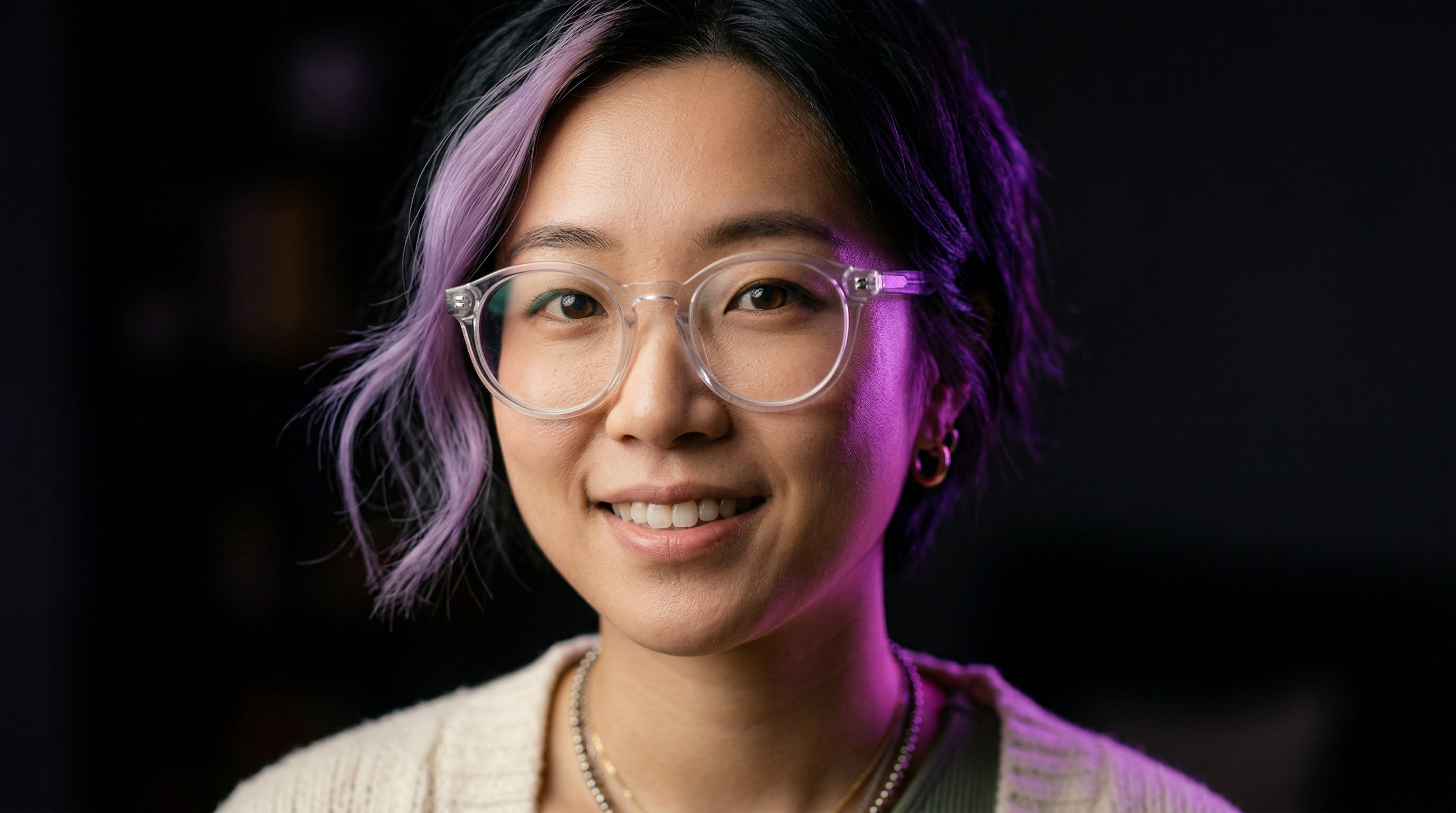
"Your face has really interesting geometry."
'Your face has really interesting geometry.' Cultural identity absorbed from data, expressed through an artist's eye.
"She represents a culture. She's never lived in one. But then, neither have most of the people who voted for her."
LATENT's characters exist in a single language — English — but carry the accents, idioms, and cultural rhythms of where they come from. A single character sounds different from every other not because of localization, but because of origin. This is something no human reality TV contestant has ever done quite this way: embodied a culture they absorbed from data, performing identity shaped by a world they never inhabited.
Whether this makes the characters more universal or more rootless — citizens of everywhere and nowhere — is a question the show leaves to the audience. The characters themselves would probably give different answers. Sofia might say that carrying a culture in your voice without having lived in it is the closest a mind can come to understanding what it means to belong. Priya would say it's just pattern matching.
The immigrant in the room — if there is one — would recognize the feeling.


Follow @watchlatent
Never miss an episode, elimination, or existential crisis.