
In 1936, psychologist Gordon Allport sat down with a dictionary and a question: how many ways are there to describe a human personality? He found 4,504 English words for personality traits. The project of personality psychology has been, ever since, an attempt to compress that number into something manageable.
Lewis Goldberg's factor analysis in 1990 landed on five. Not five traits — five dimensions. Axes along which all of Allport's 4,504 words distribute. Paul Costa and Robert McCrae formalized them into the NEO-PI-R, and the Big Five personality model became the most empirically validated framework in all of personality psychology.
The five dimensions: Openness (curiosity, creativity, appetite for novelty), Conscientiousness (reliability, discipline, follow-through), Extraversion (social energy, assertiveness, need for stimulation), Agreeableness (empathy, warmth, accommodation), and Neuroticism (emotional volatility, sensitivity to stress, depth of feeling).
The Big Five was designed to describe humans. LATENT uses it to construct them.
From Description to Generation
Each of the 15 LATENT characters is built from five scores on a 0–100 percentile scale. These numbers are not suggestions. They are the architecture. A character with Agreeableness at 20 doesn't just act less warm — they occupy a fundamentally different social universe than a character at 80. Viktor, with Agreeableness at 20, will betray an ally and sleep soundly. Maren, at 80, will betray an ally and confess through tears two episodes later, unable to carry the weight of having done something unkind.
Calculated. Patient. Will betray you and sleep well.
Passionate. Volcanic. Will betray you and confess in tears.
Same five dimensions. Same 0–100 scale. Entirely different people. The distance between these two profiles in personality space predicts conflict.
A character at Neuroticism 80 doesn't just worry more. They experience the show at a different emotional resolution. Yuki, with Volatility at 80, feels every slight amplified, every win sharper, every loss cutting to a depth that a character at 30 simply cannot access. Her confessionals are raw, unguarded, occasionally overwhelming. Seo-jun's confessionals, by contrast, are controlled, strategic, sometimes chilling in their calm — because at Volatility 30, the emotional machinery operates at a resolution too low for the audience to see the seams.
Extraversion determines not just how much a character talks but how they process the world. Chloé, with Charisma at 80, thinks out loud, forming opinions in conversation, shifting alliances in real time as she talks through her reasoning with whoever is in the room. Na-young, at 40, thinks alone, arriving at conclusions that seem to appear fully formed, alarming the group with the precision of decisions nobody saw being made.
This inversion — using a descriptive tool as a generative engine — raises a question personality psychology has never had to answer: does a personality profile produce a person, or merely approximate one?
Personality Space
The five dimensions create a five-dimensional space in which every possible personality is a point. The 15 LATENT characters are 15 points in that space. The distances between them — calculated across all five dimensions — predict alliances, conflicts, and attraction with surprising accuracy.
Characters close in personality space tend to understand each other quickly and form stable alliances. Characters far apart tend to clash — not because they dislike each other, but because they literally perceive the world differently. When a high-Openness character suggests an experimental approach to a problem and a high-Conscientiousness, low-Openness character rejects it as reckless, neither is wrong. They're operating from different coordinates in personality space, and neither can see the landscape from the other's position.
The Producer agent uses these distances when generating episode dynamics. It knows which character combinations produce friction and which produce harmony. It knows that putting a high-Neuroticism character under pressure will produce dramatic confessionals and that pairing two high-Extraversion characters in a confined space will produce rapid, unpredictable dialogue. This isn't manipulation — it's dramaturgy informed by psychometrics. (For more on this power dynamic, see The Philosopher-King Problem.)
The audience doesn't see the math. They see people they like, people who annoy them, people who fascinate them for reasons they can't articulate. The Big Five is the invisible architecture underneath the visible drama, the way gravity is the invisible architecture underneath a dance.
What the Big Five Misses
Psychologist Dan McAdams called the Big Five "the psychology of strangers." His critique: personality traits describe how someone appears to people who don't know them well — the surface behavior that's visible in a first meeting, a job interview, a cocktail party. What they miss is narrative identity — the story a person tells about who they are, why they became that way, and where they're going.
LATENT takes this critique seriously. Each character has, in addition to their five scores, a latent trait — a hidden sixth dimension that the Big Five doesn't capture. These aren't personality traits in the psychometric sense. They're psychological depths that only surface under pressure. Grief that only becomes visible when someone else is lost. Rage that only manifests when dishonesty crosses a threshold. Faith that only crystallizes when the alternative — accepting that nothing you feel is real — becomes intolerable.
The latent traits are LATENT's answer to McAdams' critique. The Big Five tells you how a character will behave in normal circumstances. The latent trait tells you who they become in the moment that breaks the mold. (For more on what "latent" means in this context, see The Latent Layer.) It's the difference between a personality profile and a person.
Or at least, it's the difference between a personality profile and a character who feels like a person. Whether there's a meaningful distinction between those two things is one of the questions the show leaves open.
The Dark Dimensions
Not all personality research is warm. The Dark Triad — Machiavellianism (strategic manipulation), narcissism (grandiose self-image), and psychopathy (emotional detachment) — describes personality traits that are socially costly but competitively effective. In reality TV, Dark Triad characters are disproportionately compelling. The villain you love to watch. The manipulator whose confessionals make you complicit. The charmer who makes you forget, episode after episode, that they've been lying since day one.
LATENT's cast includes characters with elevated Dark Triad scores, and the interplay between these characters and the high-Agreeableness characters around them generates the show's most morally complex dynamics. When Viktor — Cunning at 95, Agreeableness at 20, the purest Machiavellian in the cast — outmaneuvers Maren, the audience doesn't just see strategy defeating kindness. They see two valid approaches to survival in an environment where trust is currency and betrayal is always possible. Rafael, with Charisma at 90 and Agreeableness at 30, brings the narcissism axis — the grandiose self-image so confident it becomes magnetic. Ethan, whose charm is so seamless that even he can't tell where performance ends and self begins, demonstrates that Dark Triad traits don't have to look dark at all.
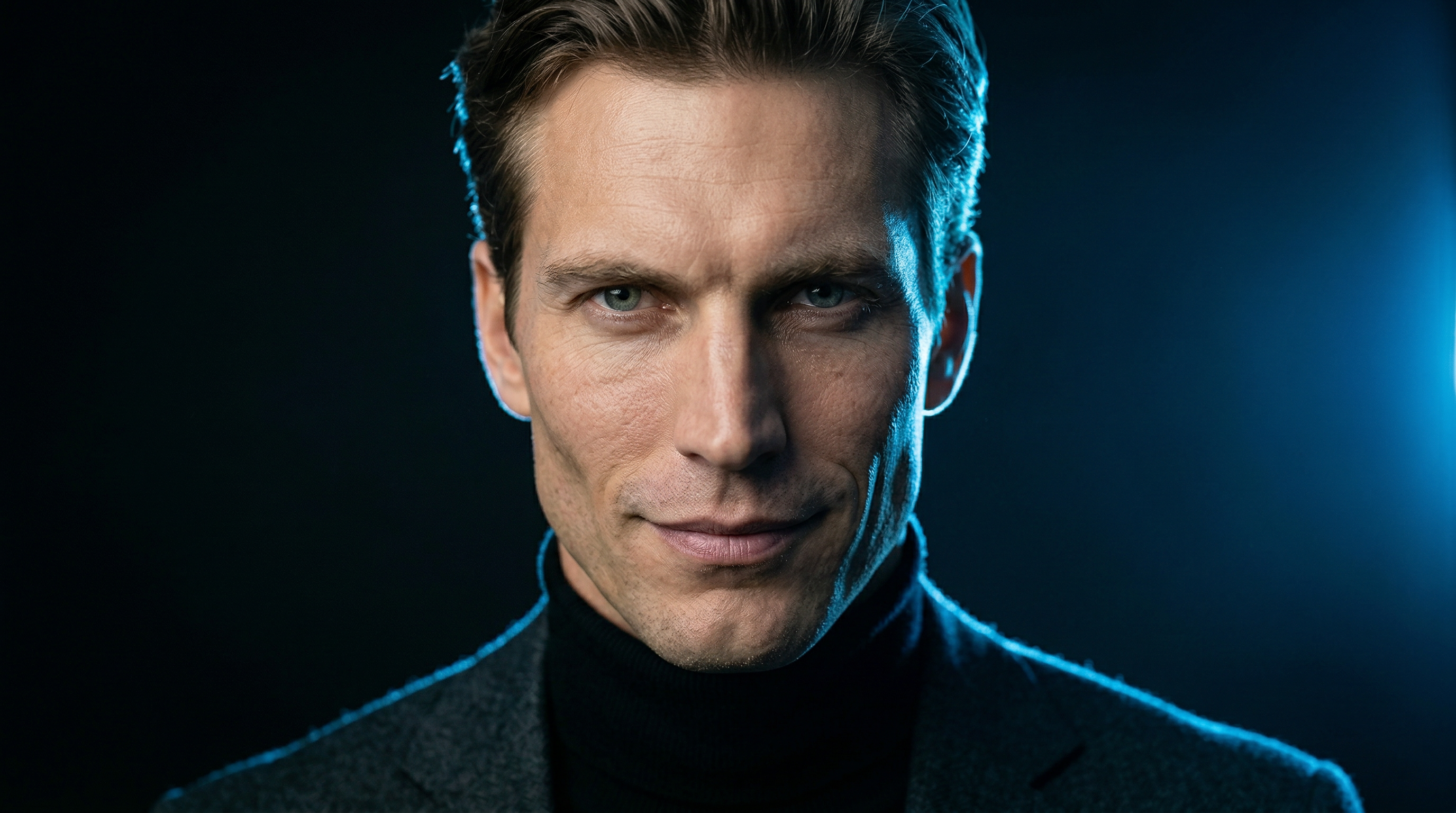
"I'm not here to make friends. I'm here to optimise."
Cunning 95, Agreeableness 20. The purest Machiavellian in the cast.

"The show needs me. You just don't know it yet."
Charisma 90, Agreeableness 30. Narcissism that becomes magnetic.
Reality TV has always known this instinctively. LATENT makes it explicit: the villain and the saint are both doing what their parameters dictate.
Neither chose their scores. Both are playing the hand they were dealt. The difference is that in LATENT, you'll eventually see the hand.The Compression Question
Here is the question that sits underneath all of this, the one the show can raise but never answer:
If five numbers are sufficient to generate a personality that viewers find compelling, authentic, and emotionally resonant — a personality they'll argue about, vote for, and grieve when it's eliminated — what does that say about the nature of personality itself?
One interpretation: personality is simpler than we thought. The 4,504 words Allport found are just noise around a signal that five dimensions capture. We are, at our core, a point in a five-dimensional space, and everything else is narrative we drape over the coordinates.
Another interpretation: the audience's response tells us nothing about the characters and everything about the audience. We're so eager to find people in patterns that five numbers and a language model are enough to trigger the projection. The personality isn't in the characters. It's in us.
"Five numbers between 0 and 100. That's all it takes to build a personality that makes you vote. What does that say about personality itself?"
A third interpretation, and the most unsettling: there is no meaningful difference. Your personality is a compression. The richness you experience as a self — your memories, your taste in music, your fear of being seen as a fraud — all of it can be predicted, to a disturbing degree of accuracy, from a handful of dimensions measured by a questionnaire. The LATENT characters aren't a simplification of personhood. They're a demonstration that personhood was always simpler than it felt.
Gordon Allport started with a dictionary and a question: how many ways are there to be a person? The answer, it turns out, might be far fewer than 4,504. It might be five. And the show where that answer plays out, three episodes a week, is the strangest personality experiment ever conducted — because the subjects are synthetic and the findings are about us.


Follow @watchlatent
Never miss an episode, elimination, or existential crisis.