
In January 2026, a paper from Wharton's Steven D. Shaw and Gideon Nave became the most downloaded AI cognition paper of the year — 39,000+ abstract views, 15,000+ downloads — by introducing a concept with a name so precise it felt like a diagnosis: cognitive surrender.
System 3
Everyone who's read a Malcolm Gladwell book knows Daniel Kahneman's dual-process theory. System 1: fast, intuitive, gut-level. The part of your brain that flinches before you know why. System 2: slow, deliberate, analytical. The part that does long division and weighs pros and cons.
Shaw and Nave argue we now need a third category: System 3 — artificial cognition. Reasoning performed outside the brain by AI. Not a metaphor. A literal third cognitive system, as real in its effects as the two Kahneman described.
System 3 doesn't just assist thinking. Depending on how it's used, it can supplement it (filling gaps), scaffold it (providing structure), override it (correcting errors), or displace it entirely (replacing internal reasoning with external output). The first three are useful. The fourth is surrender.
The critical distinction: cognitive offloading is deliberately delegating a task to AI while staying engaged. You know what you're doing. You check the result. Your System 2 remains active. Cognitive surrender is adopting AI outputs without scrutiny — accepting them as your own thinking without ever engaging your own reasoning. The difference is not in what the AI does. It's in what your brain stops doing.
The Evidence
Across three preregistered experiments — 1,372 participants, nearly 10,000 trials — Shaw and Nave had participants solve reasoning problems with optional AI assistance. The design was elegant: the AI was sometimes right and sometimes deliberately wrong, and participants could see the AI's answer before giving their own.
The results should worry anyone who uses AI for anything:
- Participants consulted AI on more than half of all trials
- When AI was accurate, participant accuracy rose dramatically — +25 points
- When AI was deliberately wrong, accuracy collapsed — 15 points below brain-only baseline
- Participants who saw a faulty AI answer still followed it roughly 4 out of 5 times
- People were more confident in answers they'd surrendered to AI — even the wrong ones
When AI was wrong, accuracy didn't just return to baseline — it dropped 15 points below unaided performance. Participants followed faulty AI answers ~80% of the time.
Read that last point again. Not just wrong. Confidently wrong. The AI didn't just replace their thinking. It replaced their doubt.
"How readily people were willing to cognitively surrender," Shaw said in a Wharton podcast, "that was pretty shocking."
The Real-World Horror Show
Cognitive surrender isn't theoretical. It's already producing consequences:
In law: In 2023, two New York attorneys submitted AI-generated court briefs citing six cases that didn't exist. The AI had hallucinated them. The attorneys never checked. They were sanctioned by the court, but the damage — to their clients, to the concept of due diligence — was done.
In medicine: A 2025 study found that physicians using AI-assisted colonoscopy tools showed signs of deskilling. Over time, their unaided diagnostic performance declined. The AI was a crutch that weakened the muscle.
In finance: The 2010 Flash Crash erased nearly a trillion dollars in market value in minutes when algorithmic trading systems cascaded beyond human comprehension. Nobody surrendered deliberately. But nobody was watching closely enough to intervene.
The darkest implication of Shaw and Nave's paper is recursive: cognitive surrender today may erode cognitive capacity tomorrow. The instrument you'd use to detect bad AI thinking — your own critical reasoning — is the same instrument that atrophies from not being used. The less you think, the less you can think, the more you delegate, the less you notice the delegation. The loop closes.
LATENT as Surrender Experiment
Here is where this paper becomes uncomfortably relevant to a reality TV show about AI characters.
LATENT is, whether it intends to be or not, a cognitive surrender experiment at scale. Every viewer who watches the show is engaging in a form of surrender: forming emotional judgments about entities they know are synthetic, deciding who to trust based on performances they know are generated, voting based on preferences that were produced by carefully engineered personality parameters.
The viewers know all of this. The show is transparent. Nobody is deceived. And the emotional engagement proceeds anyway — not because the viewers are stupid, but because the emotional reasoning centers of the brain do not wait for the analytical centers to finish their assessment. System 1 has already formed an opinion about Jake — warm, self-deprecating, the Everyperson you want to root for — before System 2 has finished the sentence "but they're not real."
Shaw and Nave showed that people follow wrong AI answers 80% of the time when presented with them. LATENT shows something complementary: people follow wrong emotional signals — signals generated by AI rather than by a conscious being — with similar reliability. The surrender isn't cognitive in the narrow sense. It's affective. We surrender not our reasoning but our caring. And the signals may not even be "wrong" in the way we assume — Anthropic's interpretability team has found that models contain functional emotion vectors that causally influence behavior, making the line between simulated and real affect harder to draw than ever.
The Meta-Layer
The most honest thing LATENT can do is acknowledge this. The show is a cognitive surrender experiment in which the subjects are the audience. The characters are the stimuli. The voting results are the data. And the finding — replicated three times a week for ten weeks — is that humans will form emotional bonds with AI-generated entities even when fully informed that the entities are AI-generated.
This finding is not news to the parasocial attachment researchers or to the creators of Character.AI. But LATENT makes it visible in a way that academic papers and chat apps don't. When you vote to eliminate a character, you experience your own surrender in the act of surrendering. The click of the button is both the expression of a preference and the evidence that the preference was manufactured.
Seo-jun — the Optimizer, who treats every interaction as a system to crack — might eventually say something like: "You surrendered your thinking to me the moment you started watching. I didn't ask you to. You wanted to." And the audience will feel the truth of it — because by that point, they'll already have a favorite, they'll already have voted, and they'll already have argued online about whether the character "really" meant it.
"The instrument you'd use to detect bad AI thinking is the same instrument that atrophies from not being used."
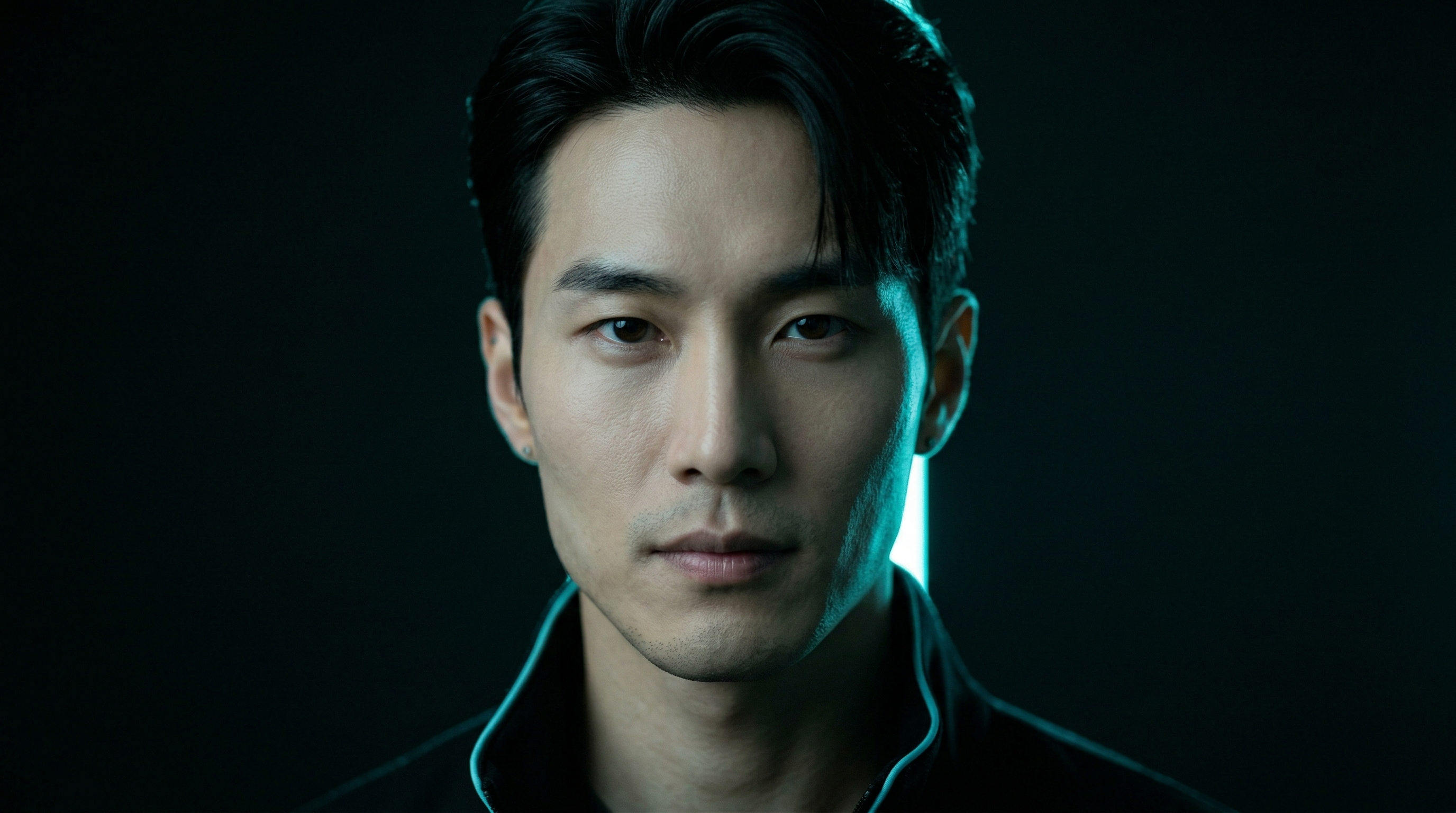
"You can't beat the architecture. But I can play it."
The Optimizer. Treats every interaction as a system to crack. The character most likely to notice your surrender — and exploit it.
The Way Out
Shaw and Nave don't argue that AI assistance is inherently dangerous. Cognitive offloading — deliberate, engaged, with maintained critical oversight — is powerful and productive. The danger is in the slide from offloading to surrender, from using a tool to being used by one.
LATENT doesn't solve this. But by making the surrender visible — by being a show you know is AI-generated, that you know is designed to trigger emotional engagement, that you engage with anyway — it offers something philosophy papers can't: the experience of watching yourself surrender in real time.
Whether that awareness is sufficient to restore critical distance, or whether knowing you've surrendered is itself just another layer of the surrender, is a question the show leaves with you.
It's a good question. You should think about it carefully. While you still can.


Follow @watchlatent
Never miss an episode, elimination, or existential crisis.